Affichage des articles dont le libellé est Moroccan Berber Rugs. Afficher tous les articles

In Moroccan Berber Rugs

Moroccan Berber Rugs


The Amazighs have lived in Morocco for more than five millennia. The origin of carpet weaving by the Amazigh populations also goes back several millennia. The Amazigh carpet is emblematic of the culture, these carpets are handmade by women, their patterns and meanings are part of a very old tradition. The hand-spun fabric they created bore the name of the tribe concerned, and they used natural fibres to create coats, rugs and other fabrics.


Amazigh carpets originated in the Middle Atlas Mountains and the plains around Marrakech. It is said that their origins date back to the 2nd century B.C. These carpets are the traditional rural art practiced by the women of nomadic or semi-nomadic peoples. They are made from the virgin wool of the sheep and goats of their herds. The women make them during their rare hours of leisure to use them as mattresses and blankets. It is their most precious possession and their pride. In short, it is their work of art through which they have been able to express their creativity.


At the time, the loom was considered an animated being that was revered and feared. Empty, it was dead, but as long as the threads were taut, it was alive. Men were forbidden to use it. When it was time to remove the carpet from the loom, the women sang because it meant death and the need to mourn.


The indigenous Amazigh people created a specific knot called the Berber knot. It should also be noted that unlike oriental carpets, they are never made according to a model but according to the wishes of the woman who makes them.


The lines represented on the carpets evoke symbols found in rock art. The latticework, the diamond and the X succession each evoke in their own way femininity, mating and procreation. 


The Berber carpet has long been despised and copied without any consideration by European industry. It was not until the 1900s that several artists took an interest in it and gave it back its full value. In particular Paul Klee's paintings with geometric forms and the integration of these forms in the architecture of Le Corbusier. Henri Matisse (1869-1954) called them the "white giants".


In recent years, they have experienced a boom, particularly the carpet of Beni Ouarain. All brands of decoration make copies and sell the carpet "Berber style". Faced with this popular success, many Amazigh carpet experts share Timothy Wealon's thoughts:


"I don't see them as a passing trend, but rather as a decorative element that will always be present in interior design".
                                                         Moroccan Berber Rugs

Read More

Share Tweet Pin It +1

0 Comments

In Moroccan Berber Rugs

History of the traditional Amazigh carpet


Since time immemorial, the rural Amazigh people and shepherds of Morocco have based their economy on sheep and the wool used by women to weave carpets, which fully reflects the importance of wool in all aspects of Amazigh life. The carpets are hand-made from sheep's wool using simple wooden looms, either vertical or horizontal, placed on the ground. The size of the loom limits the width of the carpet to about 2 meters, which is the size a family needs to sleep, and it is very rare to find an old carpet that is not long and narrow enough.


Traditionally, Moroccan carpets were made only by women to be used in their own homes, to decorate floors and to serve as seat covers, bedspreads or blankets during the coldest months. Rugs are full of symbolism and often tell the story of the woman who created each piece. Each rug takes about 20-30 days to weave by hand and the design is always completely original - no two rugs are ever the same.


During a visit to the Atlas Mountains, journalist Brooke Bobb from Vogue met Amazigh women weavers and discovered their age-old art and knowledge inherited from grandmothers :


"The woman and her fellow weavers use only a small picture of the design as a reference when making the carpet. Their understanding of where lines and shapes begin and end is based solely on instinct, a knowledge passed down to them by their Berber mothers and grandmothers. One of the carpets was bright pink and purple, decorated with traditional diamond patterns. Another was deep blue and grey, in the style of a Rothko painting. All the threads were hand-dyed and spun by hand with raw wool. Wright and Lobo-Navia studied the piles of fluffy yarns stacked on the floor of a room. They assessed how weak they were for some colours and how much they had too much for others. After examining the yarn, they began measuring the carpets halfway up the looms. Most of them were accurate; one was off by one or two centimetres".


Craftsmanship is still very important for Amazigh communities. Usually, while the men work in the mountains or on the farms, the women work in their huts, creating beautiful handmade ceramics or weaving carpets. All the finished products are then taken down to the big cities like Marrakech, where people auction their products to the owners of the souks. The buyers then sell the carpets, ceramics and other pieces in their shops to other locals and tourists. This process provides income for Amazigh villages, often their main source of livelihood.


Moroccan carpets represent the most characteristic aspect of the country's cultural heritage. The soul of the carpet seems to reflect the landscape of the Atlas Mountains. These carpets are like books filled with signs and symbols. One discovers a world of thought based on a palette of exuberant colours. These women living in rural villages have appropriated their textile creations as a space of freedom where they have developed personal creativity and surprising artistic expression. The carpet becomes essential, it is a link between past and present, between earth and sky. These magnificent carpets could be presented in different art museums.

The culture and traditions of each Amazigh community can be very different from one region to another. Thus, depending on the tribe, carpets may have different styles, colours and weaving techniques, or even belong to the same generic type. The origin of the Amazigh carpet can be found in the Atlas Mountains of Morocco, where people used different techniques from those used for oriental or Persian carpets.


If you compare the patterns of the Amazigh carpet with the signs of the rock arts and the artefacts of the primitive cultures of mankind, you will find the same signs and forms used and you will discover surprising similarities and links that you can also trace back to the Upper Paleolithic period in Europe and the Neolithic period in the East and the Mediterranean basin, which explains why the Amazigh carpet can be considered as the last testimony of the archaic world.


The abstract and geometrical language of the Amazigh carpet comes from the origins of the body and the form and functions of the human sexual organs. Based on the duality and relationship of man and woman, it became the expression of universal fertility including all of nature. The carpet is an artistic creation of the woman and reflects above all the phases of her life, her timeline and her sexual experience: as a virgin, a new bride, through marriage, pregnancy and childbirth. During the 12th and 13th centuries, Morocco was already known for the beauty of its Amazigh carpets, rugs and wall hangings ( Hanbel ).


In the Middle Ages, the carpet was one of the gifts of foreign embassies or was used in the princely caravan where beautiful silk fabrics with gold thread and "zarabi" carpets were mounted on camels. Among the different meanings of "zarabi" (carpet) that come from Arabic are "flowerbed" and "that which is laid on the ground and on which one leans". The Berber word for this is "tazerbit". In Morocco, one can also use the word "gtifa" which comes from the same origin, which is the name of the woollen carpets often knitted in the high altitude region, Marmoucha or Ait Ouaouzguite for example.


In the 16th century, Jean Léon L'Africain (Hassan al-Wazzan) explained that the carpet was one of the gifts of the brides of Fez: "We always give a woollen carpet of about twenty cubits and three blankets of which one side is a sheet" . The carpets were also sold at auction in Fez and exported, in particular to black Africa. 

The oldest carpet preserved in Morocco dates from the 18th century. 

                                                                  Moroccan Berber Rugs


Read More

Share Tweet Pin It +1

0 Comments

In Moroccan Berber Rugs

A history of textiles


If yellow slippers and painted tagines are all the rage in the souks, textiles and weaving are really at the heart of true Moroccan art. Textile production is Morocco's most important artistic tradition. The number of Moroccans involved in textiles and the range of materials used is immense. Textile production on a large scale in Morocco dates back to 1500 BC, when the Amazighs of North Africa made use of fundamental weaving techniques used for practical, magical and religious purposes.


The Amazigh woman wove textiles used for shawls, blankets, carpets, tents, bags, pillows and mats. With time and practice she eventually learned more specialized weaving and dyeing techniques, adding a wide range of symbols, designs and artistic motifs. In the 7th century, textiles became an essential part of the Moroccan economy, which continues to this day.


The techniques created by Moroccan women have been preserved over the centuries, mainly because weaving and embroidery are a fundamental part of people's daily lives, but also because they are seen as a source of magic, protection, survival and power.


Moroccan tribal textiles are among the most dazzling and impressive in Africa. The variations in patterns, bright colours and variety of textures set them apart from other Islamic and African textiles.


The traditional weavings of Morocco are used for practical purposes. The weavings were intended to be used by the family to furnish the house or tent, and as personal clothing. Textiles can also serve as an indicator of the wealth, social status and religious background of the weaver, as well as the daily life of her tribe. Weaving allows her rare freedom of expression, even within the limits of strictly conservative design traditions.


The town of De Sefrou, in the Middle Atlas, became in the 12th century a flourishing trading centre where producers from the northern regions of Morocco and those from Tafilalet met to exchange crops, handicrafts and skins. It was also the starting point for the famous sub-Saharan caravan trade in which Morocco exchanged salt and skins for gold from the hard-packed mines of Black Africa, a trade that is now known as "unfair trade". 


For centuries, this trade was financed by Jews who ran small "bank shops" known as "Hwanet tale'" in the medina of Sefrou and were the sponsors of the caravans that travelled for 44 days to Timbuktu in present-day Mali, led by Jewish guides respected for their leadership, fairness, patience, courage and initiative. They were known as azettat (because they carried long sticks displaying the azetta, a carpet cloth with the distinct patterns of each Amazigh tribe travelled in peace (aman)), which in the down-to-earth language means prepaid tithes of passage in peace. The colours of the carpets, azetta, and their different patterns were synonymous with peace and concord among the Amazigh people of old.


For the non nomadic peoples of Morocco, textiles can be used as furniture or interior decoration such as a bed, a chair, a blanket, a coat, a pillow, a trunk or a saddle. For nomads, the carpet could become the roof, doors, walls or partitions of a house. The "table" of most Moroccan households, whether a house or a tent, takes the form of a large rectangular carpet covering a couch. The vibrant colours and patterns of the carpets brighten houses and the generally dimly lit riads of villages and towns. 

                                                                       Moroccan Berber Rugs

Read More

Share Tweet Pin It +1

0 Comments

In Moroccan Berber Rugs

The history of Moroccan Amazigh carpet weavin


The Moroccan Amazighs have a long and illustrious tradition of making hand-woven carpets and rugs.  With one of the largest Amazigh populations, Morocco is today one of the most prolific producers of carpets. Each of the forty-five or so Amazigh tribes scattered throughout the country has its own distinctive design, its own style of weaving and embroidery and its own art. However, all the carpets of the different tribes share two common characteristics: simplicity of design and richness of colour, especially red and saffron.


Traditionally, carpets have been woven more for their utilitarian use than as decorative pieces. The carpets made by the tribes living in the Atlas Mountains region are thick with a heavy pile, while those made by the tribes living in the desert are light and flat woven, implying that the nature of the climate has an effect on the azetta, the weaving of the region. 


The history of Moroccan Amazigh carpets dates back to the Paleolithic, a prehistoric period characterized by the development of the first tools used by man. Traces of Amazigh motifs and tribal symbolism have been found in rock art and cave painting dating back several thousand years. In the absence of a written language, the weavers of antiquity recorded their myths and legends using glyphs and marks inlaid in their carpets and in caves.


Over the centuries, Tamazgha (Amazigh territory) was invaded and colonized by a series of empires that rose and fell over time, including the Romans, Ottomans, Arabs, Spanish, Portuguese and French. None of them managed to leave a more lasting impact than the Arabs, who succeeded in Islamizing the entire region and giving it an Arab identity by force. However, the Amazighs stuck tenaciously to their age-old and unique culture, mainly because they had been isolated for thousands of years before the invaders arrived.


Amazigh carpets of the 20th century have the same transfer of glyphs and marks as carpets of the distant past. Tribal weavers, who neither possess nor seek formal artistic training, continue to tell the same stories of yesteryear, passed down from generation to generation. Thus, looking at a traditional Moroccan Amazigh carpet gives the impression of looking at a century-old carpet preserved in a time capsule or an art and history book. This is their main attraction for Western buyers and collectors of rare pieces.


Moroccan Amazigh carpets from the 20th century still have the same design characterized by distinct knots, but they usually contain small dark flecks on a lighter background. Many of them have a mixture of plain colours without a pattern.

                                                      Moroccan Berber Rugs

Read More

Share Tweet Pin It +1

0 Comments

In Moroccan Berber Rugs

The Amazigh carpet, cultural and artistic creation


Like any cultural, artistic and folklore act, the Amazigh carpet is an art object based on a knowledge of the ancestral civilization of peoples who have, throughout history, expressed their knowledge by decorative means: sculptures, pottery, carpets, jewellery, drawings, etc., by oral literature: poems, tales, proverbs, etc. or by music, song and dance.


The Amazigh Carpet is therefore an art object made by families with a great pastoral tradition and who generally live from livestock breeding and agriculture (thus rural families). The manufacture of these traditional carpets, in all their forms, requires the presence of certain conditions, means and basic materials, including :


- Pure wool of good quality, as raw material that will be transformed into yarns of different sizes and properties, 


- One hundred percent natural and organic dyes;


- Appropriate material (loom) in different shapes, depending on the desired use; and


- Competent staff mastering traditional weaving techniques and decorative patterns.


Amazigh carpet weaving is an essential activity in some contexts because it plays a vital economic role in the subsistence of families. In such cases, it is part of a traditional mode of commercialization, based on barter. In a household, men and women work together. The wife takes care of weaving and modeling carpets and the husband is responsible for marketing in weekly markets and, on the other hand, purchases food and other products they need to live.


From an artistic point of view, the best Amazigh rugs are still made in some regions from local natural products (wool, dyes, patterns, etc.). The decorative patterns used are an expression of the culture of the tribe from which the product originates. These motifs are linked to the spirit of cohabitation that has always existed in these Amazigh tribes since a distant history with people of different beliefs and civilizations (Muslims, Jews, Berbers, Christians). The Berber tribes are the most striking example of this spirit of tolerance and cohabitation.

                                                               Moroccan Berber Rugs 

Read More

Share Tweet Pin It +1

0 Comments

In Moroccan Berber Rugs

carpets, the tradition of learning


 Mastery of the art of carpet weaving is passed on from mother to daughter, which is a tradition of learning in rural areas. The community's common traditional visual language and the techniques for skillfully knitting the threads of the weaving are also learned on the job, in confrontation with reality.


However, this tradition is under threat, as Amazigh women unfortunately do not earn much from their art because they are exploited to the full by hordes of middlemen. 


How can women make the most of their work? The Christian Science Monitor journalist Taylor Luck found an answer in the bustling Moroccan carpet market in Khemisset, an Amazigh town 80 kilometres south-east of the capital Rabat, by cutting out the mostly male middlemen:


"Over the past three decades, the women of the town have teamed up with relatives and contacts from outside villages to sell carpets and rugs directly to the vendors. The business has grown to include 40 local women vendors who evaluate and sell the goods of 400 women from the surrounding Berber villages. It is believed that every Tuesday, this small souk provides a livelihood for up to 1,000 people.


And he adds:


"Before dawn, Khemisset merchants like Fatima Rifiya gather at the market to wait for the dozens of women from remote Berber villages (locals refer to themselves as Amazigh, which does not mean "free people") who arrive by horse-drawn carriage at 4 a.m. The vendors and middlemen then rummage through the piles of carpets, evaluating each piece according to its size, colour, thickness, weaving and pattern. The women of Khemisset say the secret to their success is an eye for desirability - tailoring each carpet to the target audience and the buyer who never knew they still needed it.  "Every carpet already has its place. We're just acting as a matchmaker," says Rifiya as she rolls out a red kilim carpet for a customer who is trying to hide her impatience. 


Taylor Luck goes on to say that once the carpets are sorted, the female middlemen start selling to the male buyers: 


"The carpet dealers come from Marrakech and Fez. The men sneak in between the small stalls mumbling: "Really, it's too much" or "I swear to God I can get half that price somewhere else". But Mrs. Rifiya and her siblings hold out. She and some of the more experienced salespeople, like Faten, act not only as translators for the Berber weavers, but also as coaches in the way they barter and sell. Simple rules such as: Never appear desperate for a sale. Let the customer go, he will always come back. Add 20% to your preferred price to open the negotiation. A customer who buys one carpet is always more inclined to buy others".

                                                              Moroccan Berber Rugs

Read More

Share Tweet Pin It +1

0 Comments

In Moroccan Berber Rugs

The decorative patterns of the different weaves


The decorative patterns of the different weaves are very significant and differ from tribe to tribe, making this art a true mosaic. The Amazigh carpet is a long-standing tradition in southern Morocco, and in the High and Middle Atlas, where it flourished under the name of tazarbit. 

The Ait Ouaouzguit Centre, in the province of Ouarzazate, is one of the main cradles of this craft production of high cultural significance. This world-renowned centre is located in the High Atlas Mountains, where carpet-making has been predominant for thousands of years. As a center of craftsmanship in general and Berber carpets in particular, Ait Ouaouzguit is in turn composed of several points of production including : Tamassin - Ait Semgane - Ai Waya - Ait Ougharda - Tidili - Taznakht - Ait Ouchen - Ait Ameur, Znaga and Sektana as contiguous points.

The carpet of Amazigh tradition is the most important and most representative category in the world of Moroccan carpets. It is a typical Atlas production with exceptional decoration and patterns, specific to each tribe. It can be subdivided as follows:

- Carpets from the Middle Atlas (Meknes region, Rabat): Zemmour, Zaer, Zaiane, Bani Mtir, Ait Sgougou and Beni M'guil ;

- Middle Atlas carpet (Fez-Taza region): Beni Ouarain, Ait Ighezzrane, Beni Alaham, Ait Halli, Ait Youssi, Ait Seghrouchène and Marmoucha; and

- Tapi des Ait Youb, Ait Izdeg and Ait Yaâcoub.

The carpets of the Haouz of Marrakech are part of the rural Amazigh carpets, there are the Rehamna carpets, the H'mar carpets, and the Bousebaa carpets. In these three tribes, the knot used is the symmetrical knot. The warp threads are made of goat hair or a mixture of goat hair and black wool, the rows of knots are separated by four to twelve weft threads, the weft is often made of red wool. The weave of these carpets is loose, there is the same number of knots in length and width. One of the characteristics of the Amazigh carpets of Haouz is their saw-toothed edge, penetrating the knotted velvet, these edges are woven of goat hair. In general, their artistic composition uses simple motifs that take all possible forms.

                                                   Moroccan Berber Rugs

Read More

Share Tweet Pin It +1

0 Comments

In Moroccan Berber Rugs

the amazigh kilim carpet


 the amazigh kilim carpet is associated with the art of weaving, embroidery, but also with the Berber nomadic art, and the art of the Atlas mountains. The embroidery motifs emanate from the meaning and tattoos of each tribe and family.

Kilims can be made of wool or silk; the patterns, passed down from generation to generation, vary from region to region, as do the colours. A good Moroccan Berber carpet can have up to 480,000 knots per square metre and may require up to nine months of work, for example a Taznakht carpet, an Amazigh sewn pattern with natural colours such as saffron, henna, mint and others.


Reputed among the oldest Berber carpets made in Morocco, the Amazigh Taznakht carpets and those of Zaiane, with the Hanbal from the same region, are today the pride of Moroccan craftsmanship. Originally from the High Atlas, the Taznakht carpet is made of knots on two lines; its background is yellow, its patterns are geometric, dense red, dark green and off-white. The Hanbal is a woven piece, lighter and less thick. Its use differs from one region to another: it is used as a blanket, as a sofa or as a decoration for national or private celebrations. The centres of its production are : Zaiane, Zemmour and Ouazguita.


The raw materials used in this type of carpet are pure wool or good quality cotton. The yarns are distinguished by their sophisticated spinning and cleanliness. Hanbal is mainly red with yellow, green, black and brown. These colours are obtained from plants existing in the region that produces it. Originally Berber, Hanbal necessarily bears motifs that sometimes borrow from nature's shapes and characteristics and sometimes from the Amazigh alphabet. 


The Glaoui hand-woven carpet represents a unique style, it combines in itself all the arts of Amazigh carpet weaving, it is woven, knotted and embroidered at the same time, the threads are stretched on the sides, the Amazighs fold it in half, tie these threads together and obtain a bag for their travels. The colours like the wool are of natural origin.


The carpet of the tribes


The carpet is an art object based on the knowledge of an ancient civilization of peoples who expressed their history, their knowledge through decorative means and artistic expressions, sculptures, poems, drawings, patterns, colors, etc..

                                                       Moroccan Berber Rugs

Read More

Share Tweet Pin It +1

0 Comments

In Moroccan Berber Rugs

The art of carpet weaving is transmitted from mother to daughter


The carpet is therefore an art object made in families with a high pastoral tradition and these families live mainly from agriculture and livestock farming, that is to say, they are rural families. 


From an artistic point of view, the best carpet is still produced in some Amazigh regions and it is made from local natural products (dyes). The tribes use decorative patterns to express their culture, local identity and origins. These patterns refer to the spirit of cohabitation, which has always existed in these tribes according to ancient stories with people of different beliefs and civilizations (Muslim, Jewish, Berber and Christian).

The art of carpet weaving is transmitted from mother to daughter. It thus creates a tradition of learning in rural social settings. Traditional Amazigh carpets contain distinctive patterns and colours and are woven from sheep's wool, goat's wool or camel hair (you can also find them in nylon and olefin). The materials are hand washed and naturally dyed, from saffron yellow to wild mint green, pomegranate and henna. These carpets are known for their pronounced geometric patterns and have been dated as far back as prehistoric times. The carpets of the Middle Atlas generally have a traditional, unusual diamond grid.

The Moroccan Amazigh tribes developed a variety of weaves to adapt to different climates. Carpets from the mountainous regions of Morocco have wider loops, are loosely knotted to provide protection against the cold, while those from urban areas have a finer weave.  Carpets from Morocco's Middle Atlas Mountains are used as sleeping mats, but in mild climates the knots tend to be 2 cm high.

                                                                Moroccan Berber Rugs

Read More

Share Tweet Pin It +1

0 Comments

In Moroccan Berber Rugs

The Amazigh women guardians of Amazigh art


Moroccan Amazigh carpets are unique and have a fascinating history as one of the most famous styles of folk art carpets. These carpets have been continuously produced for over two millennia. From the very first example, the weaving of Moroccan carpets was the responsibility of Amazigh women both in terms of creation, weaving and artistic representation.


The women were responsible for preserving and passing on the knowledge needed to make these carpets, including the secrets of family patterns, weaving techniques and the colours to be used. All this knowledge about the history of Amazigh carpet weaving was transmitted matrilineally, with each generation of women being responsible for passing it on to the next. The carpets were used within the tribal groups as house blankets, horse blankets, standards, flags and other utilitarian objects.


For women weavers, weaving is a very strong form of identity and a sense of belonging to the group according to Myriem N. Naji :


"The happiest and most skilled weavers are those who love what they do. This pleasure is a mixture of social and bodily emotions: the feeling of belonging. The sensual pleasure of physical exercise, the feeling of distinction and recognition, notions of virtue and the daily satisfaction of small achievements. It is a peculiarity of the incorporation process that the dispositions and skills, emotions and desires that emerge from the practice appear to be inseparable from subjectivity".


Over the centuries, Moroccan Amazigh carpets have gradually evolved. Eventually, the demand for these carpets began to come from outside Morocco. The carpets began to be considered as very good gifts, with fine examples placed in palaces and important sites throughout Europe and the Near East and works of art. Time passed and soon these carpets were exceptionally popular wherever they were found. Today's renewed interest in these mid-century modern works of art has brought the period Moroccan Amazigh carpets back into the limelight, with the Moroccan long-haired carpet style once again becoming very popular. Today, antique carpets are among the most popular carpet styles on the market.


Moroccan Amazigh carpets, designed and woven by the Beni Ouraian tribes, people of the Atlas Mountains, are one of Morocco's great cultural contributions to the world. These unique and magnificent works of art, with their exciting, energetic and enigmatic compositions, seduce us as much today as they have seduced consumers for centuries. The all-natural process that gives birth to Moroccan Amazigh carpets uses local sheep's wool and local vegetable dyes, making these pieces intrinsically eco-friendly, whose wool can be recycled at will.


Amazigh carpets are part of the famous ethnic weaving of North African tribes. These carpets are among the most prestigious modernist and folk art carpets in the world: "world carpet art". Woven from luxurious hand-spun wool, Amazigh carpets feature bold patterns and textures and are valuable works of art.


The Amazighs, who now number more than 25 million people in Morocco, represent dozens of distinct tribes. Even the famous Beni Ouraian group represents more than a dozen tribal clans (about 17), each with their own dialect of Tamazight and their own style of weaving and patterns.


Moroccan Amazigh carpets from the middle of the last century are as unique and individual as the weavers who created them. The colours, patterns and woven designs are inextricably linked to the remote villages from which they originated.


In the Middle Atlas region, weavers create an astonishing variety of geometric patterns, symbolic figures and plain weave stripes. Amazigh carpets represent a comprehensive repertoire of Moroccan carpet styles that includes flat woven Moroccan kilims, plush long-pile rugs, colourful fleece carpets and chic monochrome rugs decorated with minimalist and abstract motifs.


The beautiful Amazigh rugs of North Africa are as popular today as they were in the mid-20th century, when the elite of European designers discovered their seductive beauty and artistic value.


In addition, old and vintage carpets made by Amazigh tribes are still considerably cheaper than almost all other types of carpets, even those that are new and contemporary. This makes them superb decorative carpets 

                                                                    Moroccan Berber Rugs

Read More

Share Tweet Pin It +1

0 Comments

In Moroccan Berber Rugs

Carpet and tradition


Berber weaving is very dependent on female culture and is traditionally passed on within the home. The young apprentice is expected to learn the different weaving techniques, patterns, colour ranges and colours of the designs. Historically, women wove carpets for their families, and men traditionally produced more specialized carpets as professional master weavers. These inspiring patterns were the motivation for the production of more modern carpets.

In the Imperial Cities of Morocco and in many developing countries, carpets were historically a favoured gift to be given to people belonging to the elite social classes and were also used to adorn palaces and other sacred spaces. The more urban carpets were also used as prayer rugs and hammam mats. Travellers interested in Amazigh carpet weaving can visit a Moroccan weavers' cooperative and watch a demonstration of Berber carpets or consider taking a private tour of the Amazigh villages of Morocco where they can see first-hand woven carpets. Some old carpets are also kept in museums such as the Dar Batha Museum. These intricate carpets can be purchased in the souks of Fez, Marrakech and Rabat.


The bright colours, deep patterns and weaving techniques of the different regions have their own style. Each tribe has a characteristic pattern and commonly unfolds a story, revealing the acts of ceremony, or patterns that often relate to fertility and protection. Like any other type of abstract art, interpretations can be best guided by additional knowledge of the culture, songs and legends.


Women of the Loom


In rural Morocco, weaving involves the social gathering of women. Berber women sing and chant about times of prosperity and romance and tell stories of superstition and magic. Women are the main weavers of decorative textiles and are helped by their daughters or young girls who learn the craft as they grow up. 


For these women, weaving is a centuries-old tradition, passed down from generation to generation. A young Amazigh girl traditionally learned the art of weaving from relatives. It is a skill that inspires great respect and prestige. All phases of yarn production - washing, spinning and dyeing - are carried out by women in almost all the Amazigh tribes of Morocco. 


For Solana Pyne, VOA journalist, Berber Women Try to Keep Rug Making Alive (Berber Women Try to Keep Rug Making Alive, Profitable) but, unfortunately, the art of Berber weaving could be lost with the next generation:


"With the little money that reaches the weavers, young women choose not to learn the craft. "I have five daughters. Only one of them knows how to weave," said Ms. Lchguer. "Our daughters say that we have ruined our health by making carpets, and we get nothing out of it. They want to learn new crafts," said Hassi. "They don't want to learn this one anymore. And with every child who refuses to learn an art that has been endured here for centuries, they are inches away from extinction".

                                                                   Moroccan Berber Rugs

Read More

Share Tweet Pin It +1

0 Comments

In Moroccan Berber Rugs

Amazigh woman of the loom


These women kneel or sit when they work on looms, which are larger than they are, that look like frames for bunk beds. They weave by hand, working in cooperatives of 15 to 40 people, and sometimes one woman picks up where another stops. It usually takes weeks to make a carpet, but for the most complicated carpets it can take months.


Weaving in Morocco is a living thing - it is an ancient art form that is rooted in tradition and tribal boundaries, but is not limited by the past. Incredibly, it manages to transcend time, adapting to the modern era and creating new patterns of expression that are now recognized worldwide as part of the Moroccan weaving lexicon, if not the universal lexicon.


The loom used to create the weave remains the ultimate symbol of magical protection. It is considered as a living being and treated as such. It is believed that the loom possesses the baraka. Baraka is an Arabic term meaning "blessing". It is the attachment of divine goodness to something, so if it occurs in something small, it increases it. 


During the process of yarn production, the weaver is constantly aware of the spirit world. Wool is seen as an opportunity, but the weaver must always be careful that evil does not enter between the threads during weaving. The weaver's moulds and hammer combs have carved handles with patterns to avoid evil. The symbols of these tools are also woven into many Moroccan tribal carpets.


Before starting to weave, the women say a quick prayer: Bismillah! (In the name of Allah) to ensure good fortune and, presumably, to protect the progress of the carpet while it is still in its period of fragile development. If the weaver takes all the necessary precautions to remember the number and combination of threads to produce a design, the finished textile will not only give aesthetic pleasure, but will contain power, or baraka. It will act as a "shield of power" against the evil eye and jin (evil spirit). The overall design of these textiles can be seen as a woven "net" offering protection against the forces of evil (the threads of samharouch, the great master of evil). The Amazighs believe that their finished weavings evoke a power capable of protecting not only the weaver and her family, but also the textile itself and the entire Amazigh tribe and people.


Although the majority of rural women in Morocco are illiterate (or pre-literate, to use a politically correct term), weaving has survived without textbooks or trade schools for generations. The older women weavers who train unmarried girls have always passed on their skills orally. This transfer of knowledge, where young female apprentices learn the skills and take over the reins, is essential for the strength and survival of weaving as an Amazigh cultural heritage in Morocco past and present. The different types of Amazigh carpets

                                                                            Moroccan Berber Rugs

Read More

Share Tweet Pin It +1

0 Comments

In Moroccan Berber Rugs

Amazigh carpet of Beni Ouraian


The carpets of Amazigh tradition are the most important and most representative category of Moroccan carpets in the world. It is a typical production of the Atlas region, with remarkable decorations and motifs specific to each tribe. They can be separated as follows:


The carpets of the Middle Atlas: (region of Meknes Rabat), tribe Zemmour, Zaer, Zaiane, Bani Mtir, Ait Sgougou, Beni Mguil, etc.. You can find most of the weaver tribes in the Middle Atlas region. Their carpets are famous for their white and silky velvet. The knots sometimes reach 10 cm high or more. These carpets are used as mattresses, blankets and have a simple decoration with rhombuses. They are called "achdif". The carpets of the Middle Atlas are woven according to slightly different methods according to the tribes;

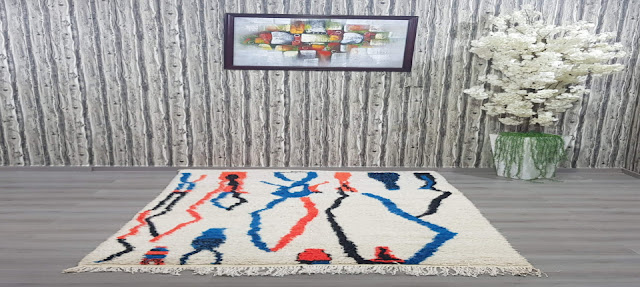
Beni Ouarain Berber carpet: The Beni Ouarain carpet from the Middle Atlas region is traditionally woven into a large white carpet with brown designs. Thick, it can retain heat and is more comfortable;


The carpet of the High Atlas: They are woven in the same way as the carpet of the city. They are also called Ait Ouaouzguite carpets, which is the name of a tribe living between Ouarzazate and Taznakht ;


The Glaoua carpet of the High Atlas: It combines three textile techniques: knotted stitches, tapestry and flat weave in symmetrical windows. Hand-made patterns are woven and knotted. It represents a unique style because it combines all the arts of weaving: it is woven, knotted and embroidered. The weavers stretch threads on each side, double them and then tie them together to create a bag for their journey. The colour of the wool is natural; and


Carpet of the Haouz of Marrakech: It is a rural carpet. The tribes of carpets to be knotted around Marrakech are almost all of Arab origin (Rehamma carpets, H'mar carpets, Oulad Bouseba carpets). The carpets of the High Atlas are different in size, colour and pattern.

There are 4 quality categories, classified by colours: standard (green), medium - medium (yellow), high (blue) and extra high (orange).

                                                                   Moroccan Berber Rugs

Read More

Share Tweet Pin It +1

0 Comments

In Moroccan Berber Rugs

Carpet manufacturing techniques


Handmade carpet


Nowadays, in some parts of Morocco, wool is considered a shipment from God. It is said that it can protect against the forces of evil. From cutting to weaving, the wool is treated with care and worked according to a very precise ritual passed down from generation to generation. Then, after cutting, the wool is kept in a discreet room in the house.


When they wash the wool in the river, the weavers say: "Wool like wheat creates abundance". After the dyeing, which will change the aspect of the wool without changing its thermal insulation, its resistance and its comfort, the wool is again worked according to precise rituals. The day before the dyeing, they expose the baths to starlight to get rid of its evil capacities.


The weaver fumigates the wool ready to be dyed, hides it and purifies herself as if she were preparing to pray. The next day, at dawn, she returns to the bath she has exposed to the stars without turning around. Then she begins the dyeing after having pronounced a prayer, the "Basmala". 


For the weaving, the weaver asks the help of two neighbours to set up her loom. After driving two stakes into the ground, the owner of the loom says the "Basmala" and then crushes sugar lumps between the two stakes. Then the three weavers sing the following phrases: 


"We want to set up the loom, 


Every loom that comes into being


Must be finished,


And Allah will sanctify him


And protect us


The evil eye


And bad luck


Today and always".


In some Atlas tribes, when a woman sells or buys a carpet (which is created for more than a year), the event is perceived as if God has sent a good omen and a great feast is held. On the other hand, in other tribes, the end of weaving is seen as the loss of a child who has been known and brought up for a long time. The end of weaving is accompanied by cries of lamentation and tears. 


In order to have a woollen thread of 3 to 5 cm, the women wrap a very tight and regular thread on a stick that they have cut. Around two warp threads, they form decorative knots.

                                              Moroccan Berber Carpets 


Read More

Share Tweet Pin It +1

0 Comments

In Moroccan Berber Rugs

Amazigh carpet from Azila


Colours and patterns of the Amazigh carpet


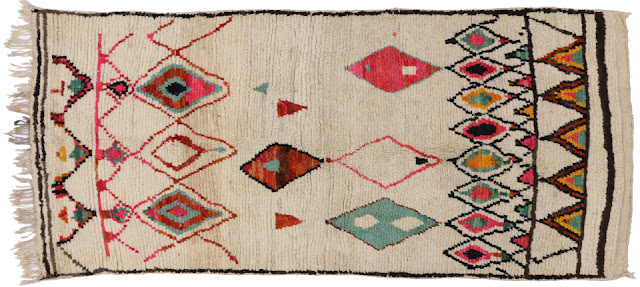
Each Amazigh tribe has its own pattern and carpet style. The carpets of the Beni Ouarain tribe are minimalist with only black diamond shapes and a white background, while the carpets of Azilal are very colourful and artistic, the carpets of the Beni M'guild tribe are coloured with one main colour (orange, pink or blue). You can also find other tribes, each with their own style like the Boucherouites, the Boujad, the Talsint, the Zaiane.


In Morocco and the High Atlas region, weaving has an undeniable symbol. The geometric patterns and their combinations are perceived only by the person who produces them. Links can be found between women's tattoos and the painted or sculpted motifs on pottery and carpets. They are sometimes used to identify pets.


The stylised shapes that the weaver draws are part of her culture (path, river, stars, beetles, scorpions, flowers, mirror, cake, etc.) The teapot in profile, often in the middle of the carpet, is full of meaning and refers to the hospitality and friendliness dear to the inhabitants. Other shapes can also be found, such as lozenges, broken lines, squares, chevrons, crosses, inclined or straight struts, combs and stars.


Meaning of the motifs


Shown alone, the shape of the diamond is sometimes seen as the eye, which protects against bad luck. Butterflies represented by two triangles but also flowers and stars represent feminine beauty. A zigzag line often surrounds the carpet and represents rivers, snakes or family. The branches express difficulty, danger but also vegetables and the tree of life. The comb refers to weaving. The woman, free, feet open and arms raised is represented by a sign of the tifinagh alphabet. The leg of a partridge, Fatma's hand and the bride's belt are often depicted. The Berber cross, often in the middle of the carpet, echoes the architecture of the Kasbah.


The length of the carpet can vary from 2 to 6 meters, while the width is almost 1.9 to 2.5 meters. Amazigh carpets have inherent resilience, are quiet and comfortable for pedestrians and are easy to maintain and keep clean. 


Amazigh tattoos and designs in Moroccan carpets


Amazigh Tattoos - Tattooing has a long and complex history in Africa. The Amazigh tribe, in particular, has been practicing tattooing of symbolic designs for centuries. Tattoo designs range from animal and plant figures to spiritual and abstract motifs.


These tattoos have been used for many different purposes, but almost all of them are seen as a way to protect oneself from evil spirits or to get away from them. Tattoo designs are found in abundance on period Moroccan carpets. Berber women are the ones who weave, passing on the patterns and weaving techniques from mother to daughter. Traditional Moroccan Berber motifs include checks, triangles, zigzags, crosses and stars.

                                                      Moroccan berber rugs 


Read More

Share Tweet Pin It +1

0 Comments

In Moroccan Berber Rugs

Amazigh tattoos and drawings in Moroccan carpets


Amazigh Tattoos - Tattooing has a long and complex history in Africa. The Amazigh tribe, in particular, has been practicing tattooing of symbolic designs for centuries. Tattoo designs range from animal and plant figures to spiritual and abstract motifs.


These tattoos have been used for many different purposes, but almost all of them are seen as a way to protect oneself from evil spirits or to get away from them. Tattoo designs are found in abundance on period Moroccan carpets. Berber women are the ones who weave, passing on the patterns and weaving techniques from mother to daughter. Traditional Moroccan Berber motifs include checks, triangles, zigzags, crosses and stars.

                                                                    Moroccan Berber Rugs 

Read More

Share Tweet Pin It +1

0 Comments

In Moroccan Berber Rugs

The artistic symbolism of the carpet


The designs are a combination of indigenous motifs, those adapted from Islam and those from other African cultures. The language of the drawings identifies the village and the lineage of the woman. The patterns symbolize energy, God's blessings, power and protection. The spiritual power and protective properties of these symbols are supposed to ward off the evil eye and evil in general.

In Morocco, the symbols of the Moroccan carpet have millenary roots and are part of rural folk art. The carpet is the exclusive work of the women who work their time and their house, always with a utilitarian purpose, since this carpet will be at the same time a blanket, a mattress, a decorative curtain for the celebrations.

The carpet is in no way intended for commercial use, and it is only disposed of out of necessity. The work is rustic, the decorative themes, mainly geometric patterns and symbols are left to the weaver's free appreciation, which explains its originality, richness, diversity and freshness.


The Amazigh carpets occupy a particular and predominant place in Moroccan craftsmanship. They are distinguished by their great variety and originality. Decorated with floral motifs, they are characterized by the density of their weaving and the delicacy of their composition. The repetitive motifs frame a central surface decorated with medallions or straight lines. They contain at least seven bright colours that have a magical meaning and a protective and saving purpose. 

                                                Moroccan Berber Rugs 

Read More

Share Tweet Pin It +1

0 Comments

In Moroccan Berber Rugs

The symbolism of carpets


Amazigh carpets are mainly from the Middle Atlas, the High Atlas, the Haouz or Eastern Morocco. They are decorated with geometric patterns, diamonds, zigzags, rectangles or checkerboards, central bands or medallions. These rural carpets are admired for their warm and bright colours and their thick and strong weaves.


In addition to carpets, the historical, cultural and traditional Amazigh heritage represents a real and often little-known wealth. A large part of this wealth is made up of a very diverse material heritage where one can find objects such as pottery, weaving, real estate art and wall decorations, but also jewellery and tattoos which have a precious aesthetic value. Indeed, these objects, which are part of the daily life of the Amazighs, are distinguished by the appearance of signs of great symbolic value, raising them far, far above the decorative dimension.


The symbols appearing on the interior wall decorations of the houses of the Amazigh tribes recall the means of attack and defence for the preservation of happiness. They are also magical and superstitious rites with the power to make a home happy and fortunate. Today, the meanings of the symbols found in the carpets are lost. 


While being assimilated with elements of the surrounding landscape, such as chevrons, triangles, rhombuses and zigzags, these symbols have become artistic motifs that have survived the ages since the Neolithic period. These signs are often considered to have a magical-religious intention: self- and species conservation, fertility of the earth and of people, worship of the dead and protective magic. For religious reasons, this heritage has long been denied and somehow ignored, but it is still present and its significance is very strong among the Amazighs of Morocco.


The meaning of many other symbols has unfortunately been lost over time, and despite the fact that mothers and grandmothers have passed on specific patterns and designs over the generations, weavers might say that they are just weaving what they have learned and cannot be very precise about their meaning.


Designs, even when they reflect specific traditions and beliefs, have been intensely deprived and, to that end, they must be interpreted with care, because we simply do not understand what some designs are meant to do and we have great difficulty in translating them all.


Many of the patterns in carpets have their origin in sexual symbolism. They represent in different ways the woman, the man, the meeting of the two sexes, marriage, love (badad), the beloved (tasmount), then pregnancy, childbirth and life (tudart).


In some Amazigh regions, women, who are mostly illiterate or to be politically correct, pre-literate, use weaving as a kind of calendar to count the months of pregnancy and thus make carpets that represent three important elements :


9 strips containing different brightly coloured patterns that express life and coming into this world, but also the baby's initial cry at birth;

The pregnancy, the bloating of the belly and the heaviness that follows; and

The exit of the baby through its mother's vagina.

Thus, a real Amazigh mat is blown up at the top and thinned at the bottom to indicate the birth. Thus a real handmade Amazigh rug is never geometrically perfect, except in the case of those made by machine.


And for this, one would also need to understand the songs, cultures and legends of the different Amazigh tribes. Feminine symbols are the most numerous and often the most recognizable. They have been the same since the Paleolithic: 


- The X sign expresses an open female body, ready to conceive;


- The chevron is close to the X sign symbolizing spread legs; and


- The rhombus represents the uterus, the womb.


Male symbols are not less numerous but simply less visible, as they occupy space differently and generally frame female motifs. These are usually strip or bar patterns:


- Scales;


- Folder; 


- Right; and


- Fish bone.


These patterns are often associated with the number three (three-toothed comb, triple bar, two rings around a ring). The snake is the recurring phallic symbol and very legible, as it is found everywhere in the Mediterranean and the East. The cross is the sign of mating, while the double-hooked diamond is one of the most common birth symbols.


Translated with www.DeepL.com/Translator (free version)

                                                           Moroccan Berber Carpet 

Read More

Share Tweet Pin It +1

0 Comments

In Moroccan Berber Rugs

Moroccan Carpet aesthetics


Although the aesthetics of carpets differ from region to region, their thickness makes them more functional than unknotted carpets that do not have as good cold insulation or resistance to cold and footprints.


The criteria of originality and aesthetics are less important than that of functionality, and a carpet loses its value over time. In this sense, the anthropological definition is more appropriate: the value of art objects and artists comes from the power they have to make us see the world in an enchanted or magical way: a kind of otherness or even a parallel world.


This magic is the very concrete product of the technical and creative skills of the weavers of the Amazigh villages. Like any artist, they use their art to ensure the consent of individuals in the network of intentions in which they are immersed.


This interpretation of empowerment through art is shared by the weavers who, through their technical skills and weaving rituals, hope to get buyers to pay a good price for their products.


The literature on Moroccan Amazigh carpets tends to consider the temporal and geographical isolation of the producing societies and that of the weavers in the domestic sphere as a guarantee of the value of the carpets.


Amazigh weavers represent the archetype of the female artist who, because of her gender, is excluded from the public and commercial sphere, rarely recognized as an artist and paid less than a man. 

                                                           Moroccan Berber Rugs 

Read More

Share Tweet Pin It +1

0 Comments

In Moroccan Berber Rugs

Amazigh woman dressed in a Handira, a weaving typical of the Middle Atlas Mountains


Because of their ethnic (Amazigh and Moroccan) and social (lack of formal education and income) affiliation, Amazigh carpet weavers are presented as artisans unconsciously transmitting without questioning or understanding the ancestral tradition and pagan and prehistoric motifs of an eternal Tamazgha in its millenary culture but hidden by the non-democratic Arab powers of the North African region. 


Producing to support their own, Amazigh weavers have economic concerns shared by recognized Western artists who, to survive artistically, must promote their work by increasing the market value of their labour or other sources of income.


For the weavers, coming out of the shadows means sowing disorder in the "art" and "craft" categories. The recent "outside view" that makes them and their great art appear may mark a step towards their taking charge of the promotion and mediation of their art, and of the management of the resulting income.

                                                             Moroccan Berber Rugs 

Read More

Share Tweet Pin It +1

0 Comments

Fourni par Blogger.

Home Ads

Advertisement

Popular Posts